|
|

| :.NAVIGATION.: |
| >Organization |
| >Branches |
| >Programming |
| >Ukrainian Education |
| >Visnyk Online |
| >Services |
| >Bazaar Online |
| >About Ukrainians |
| >Who's who |
| >Links |
| :.EVENTS.: |
| > What's New? |
| > Events Calendar |
|
:.LANGUAGE.: |
 Українська версія
 |
| :.COORDINATES.: |
| Ukrainian Canadian Congress Saskatchewan Provincial Council 980-606 Spadina Cres. East Saskatoon, SK S7K 3H1 Phone: (306) 652-5850 Fax: (306) 665-2127 E-mail: uccspc@ucc.sk.ca |
| What's New |
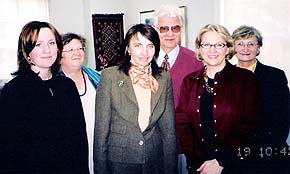
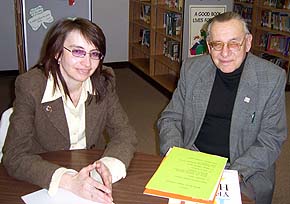
Ukrainian language teachers and learners benefit from classroom research and language assistanceNadia Prokopchuk, Ukrainian Education Consultant, Saskatchewan Learning March 30, 2006 -- During the winter term of this academic year, the Prairie Centre for the Study of Ukrainian Heritage at St. Thomas More College (STM), University of Saskatchewan, hosted a visiting professor from Ternopil’ National Pedagogical University (TNPU) in Ukraine. Dr. Olena Huzar, Chair of Ukrainian Philology, was the recipient of the prestigious postdoctoral Neporany Fellowship from the Canadian Foundation for Ukrainian Studies, administered by the Canadian Institute of Ukrainian Studies at the University of Alberta. Dr. Huzar was able to continue her research on the manuscript entitled Theory and Practice of Ukrainian Orthography in the Twentieth Century, and to teach an intermediate level Ukrainian language course at STM. Dr. Huzar’s continuing professional interest in the area of Ukrainian language education also led to collaboration on two initiatives with Saskatchewan Learning and the Saskatchewan Teachers of Ukrainian (STU). These initiatives will no doubt have positive benefits on teaching and learning strategies used in Ukrainian language programs at all levels of instruction, including Pre-Kindergarten, K-12 and post-secondary programming.
The STU conference session, titled ‘English Language Interference in Ukrainian Language Learning”, brought to light some problem areas where the influence of English was most evident. For example, English-speaking students quite naturally transfer the use of verbs such as любити (to like), дістати (to get) or покласти (to put) into Ukrainian sentences. In many cases, a more accurate or more specific Ukrainian verb is needed for clarity. Confusion with ‘false friends’ and ‘false cognates’ is another common problem in Ukrainian, as well as most other languages. In the case of false cognates, a Ukrainian word may sound similar to its English counterpart, yet its meaning or interpretation may be different when used by native speakers. Examples include мітінґ (meeting/ rally), фіскувати (to fix/to affix), графік (graphic/schedule/timetable), формально (formally/superficially), сеанс (séance/repeated sessions or shows). False friends are words which may carry two different meanings, often as a result of historical circumstances, cultural assimilation or local preferences. Examples include words such as овочі (fruit/vegetables), машина (machine/car), ручка (small hand/handle/pen), перо (pen/quill), пара (pair/steam/university class).
The STU session offered a number of practical suggestions for alternate verb choices, presentation of language variations and the use of synonyms, when appropriate. These suggestions can easily be incorporated into classroom instruction. Canadian speakers of Ukrainian have a strong background as English language speakers and it is not surprising that a “fresh set of eyes and ears” is needed from time to time in order to analyze what has become a very natural transfer of language skills from the majority language to the minority language. Saskatchewan Ukrainian language teachers were fortunate to have Dr. Huzar provide this fresh set of eyes and ears on the topic of language transfer. A second and more extensive collaborative venture with Dr. Huzar is in its initial stages of development and promises to be of major benefit to Ukrainian language learners at both the provincial and national level. The project involves the development of a Ukrainian pilot version of the European Languages Portfolio (ELP) for English speakers of Ukrainian. Language specialists and government officials from several provinces have strongly recommended that the European Languages Portfolio be adapted, piloted and promoted for all Canadian languages. Saskatchewan Learning has stepped up to the challenge by supporting the development of Ukrainian versions of the portfolios for field testing in our province. Dr. Huzar’s input into the initiative continues to be invaluable. Dr. Huzar’s work with the students and teachers in the province
is truly appreciated. It should be noted that university students
across Canada will continue to have an opportunity to study with
Dr. Huzar and the Ukrainian language professors in her department
through STM’s Summer Study Abroad Program with Ternopil’ University.
|